One of the most interesting projects in the Holochain ecosystem is Moss from Lightningrod Labs. Moss is peer-to-peer groupware, a framework where groups can spin up their own collaborative spaces and add exactly the tools they need. Chat, video calls, documents, task boards; whatever helps the group do its work together.
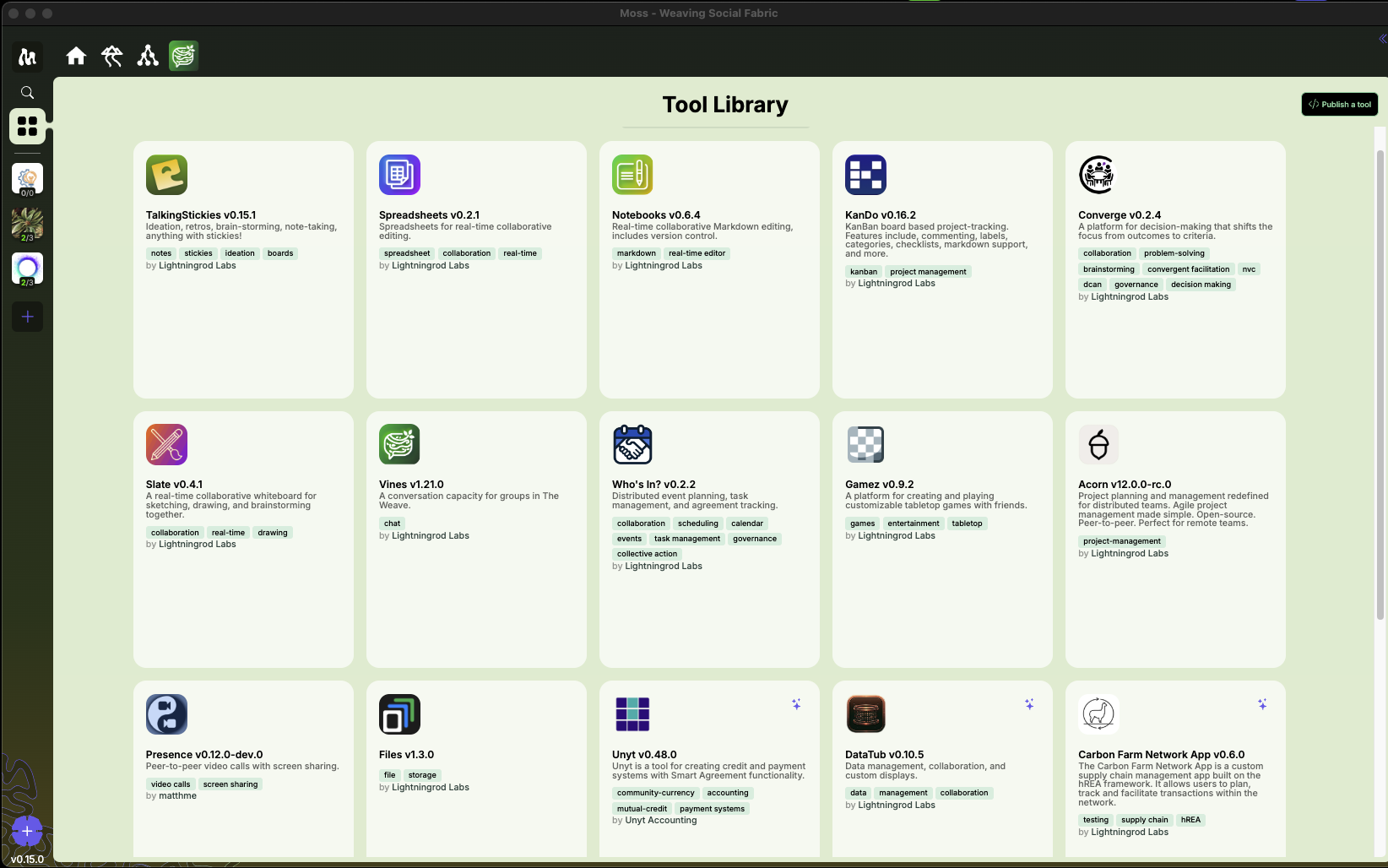
And now, alongside their other collaboration tools, Moss groups can now use Unyt for peer-to-peer payments, custom currencies, and Smart Agreements. And they can do so with ZERO gas fees and ZERO transaction fees.
Let's dive into the possibilities this newfound FREE-dom opens up.
How Moss Works: Tools for Groups
In Moss, you create and join groups. This side of Moss is kind of like creating a Discord server or a Slack workspace. Any particular group creates a social context: the people you're coordinating with.
Members can then add tools into a group. Tools are standalone Holochain applications that you can access from inside Moss. A spreadsheet tool. A chat tool. A document editor. Each tool you add gives your group new capabilities. This side of Moss is a bit like a web browser. It allows you to interact with applications — except that these applications run peer-to-peer, rather than on some corporation's server.
When you add a tool to your group, you're not connecting to Google, Apple, or Microsoft. You download and run the application on your own machine, and you and the other participating group members run that application together, peer-to-peer.
When someone installs a tool and indicates that it is for a particular group, the other members of that group get invited to join the app by activating it themselves. But each participant gets to decide for themselves which tools they want to make use of and participate in.
This composability is one of the things that makes Moss powerful. Groups assemble exactly the capabilities they need. Eric Harris-Braun, one of Holochain's co-founders, has a whole philosophy and vision about this different way of enabling communication that he calls "The Weave".
If you are curious to geek out a bit more, Holochain & The Weave: a story of free is a great introduction. For an even deeper exploration of the same concepts and their implications, there's Aliveness and The Weave, an interview filmed by Katie Teague last year.
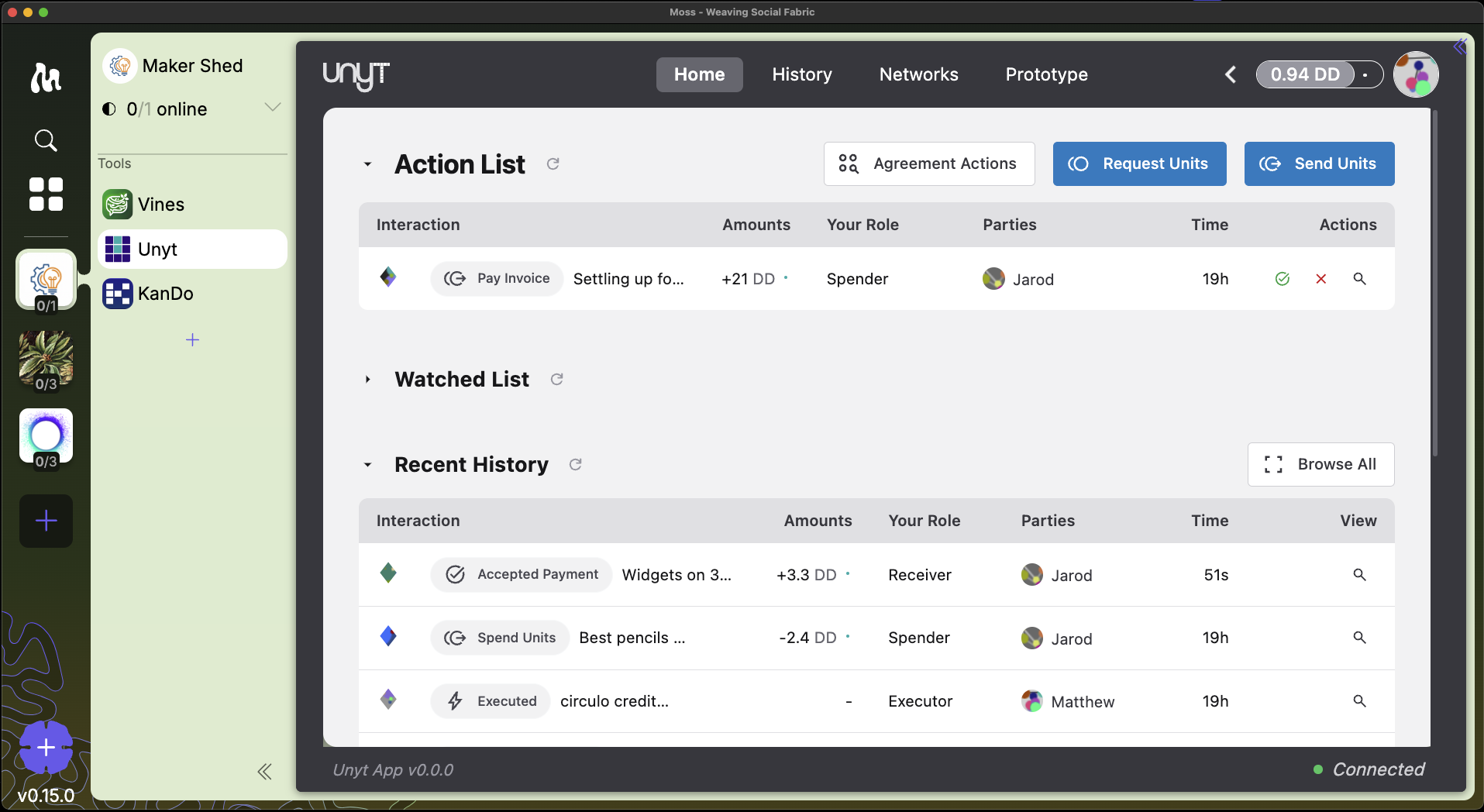
What Unyt Adds: Economic Coordination
Unyt provides accounting and payment infrastructure built on the same Holochain foundation as Moss.
Now with Unyt available on Moss, the same way you add a chat to your group, you can add a payment currency, invoicing, or Smart Agreements that automatically bill for services rendered.
This brings economic coordination into the same space as social collaboration. But more importantly, it democratizes the design of that coordination.
The "Not-So-Dark" Art of Currency Design
Designing an economic system used to feel like dark magic reserved for central bankers or more recently, high-level protocol engineers. Unyt changes that.
With the Currency Design Wizard built into Unyt, setting up a currency system is no longer a black box. You don't need to get a PhD in complex monetary policy theory. You can just dive in, and the wizard walks you through each step. Currency design is now just another tool that you can play with. You can make some choices and then try out that structure with your group, see how it goes – then make a change and experience the shift in how the group works.
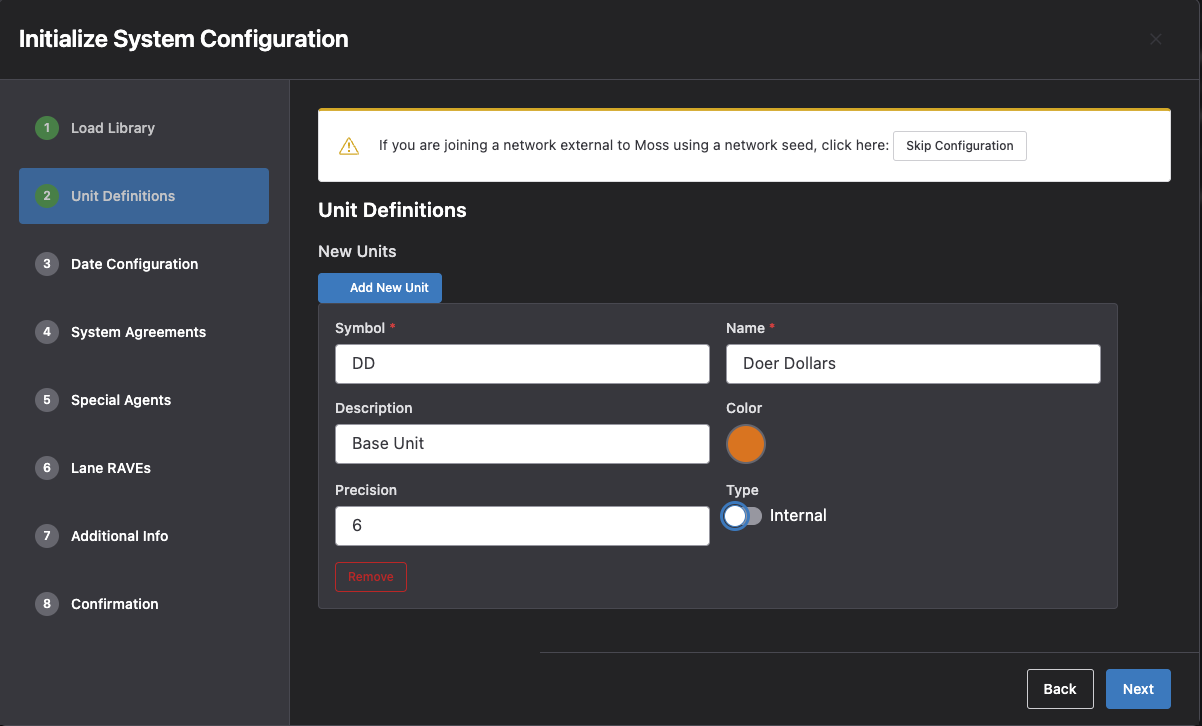
What things does your community want to pay attention to? How do you want agreements to be structured? Who is allowed to take a particular kind of action? Unyt puts these levers in your hands, turning currency design into a creative act of community building rather than a technical hurdle.
To Fee or Not to Fee. Is that even a question?
One of the most powerful choices you have is around transaction fees.
In the traditional world (and much of the crypto world), fees are mandatory. They pay for the network. In Unyt, because your participants are running the infrastructure themselves peer-to-peer, you have a choice.
- Zero Fees: You can set up your economic system to run with ZERO gas or transaction fees. This is perfect for mutual aid groups, time banks, or internal family accounting where extracting value from transfers doesn't make sense.
- Sustainable Fees: Alternatively, you can choose to include transaction fees. These might go to the community organizers to cover operational costs, or even to pay for support from Unyt in helping design and maintain your system.
The point is: you decide. The economics serve the community, not the other way around.
For now, I'd suggest just diving in and trying to create your own FEE FREE currency systems just to experiment and experience.
Two Ways to Use Unyt in Moss
There are at least a couple of distinct patterns for how groups can use Unyt in Moss:
Pattern 1: Private Accounting for Your Group
Imagine a Community Makerspace. A group of 50 or so members creates a Moss group to coordinate their workshop. They install Unyt to handle membership dues and equipment usage.
Members pay dues and get issued "Workshop Credits," which they can use to access the shop and its machines. If someone wants to use the laser cutter or the 3D printer, that is included. If they want to use the expensive-to-run water jet, that costs extra credits per minute of cutting time. Members who teach classes earn credits from the students who attend.
Everything happens peer-to-peer. Inside of the Workshop Credits economy, there is no separate payment processor, no point-of-sale system taking 3%. It is economic experimentation at a small, autonomous scale.
Pattern 2: Participate in a Wider Network
Maybe your group doesn't want to create its own currency but wants to use one that is already widely accepted, like a regional community currency -- something that is accepted by hundreds of local businesses in your town.
You are still coordinating within your own Moss group, but instead of creating your own Unyt app, you are choosing to participate in a payment network that includes a much larger community. This gives you a larger set of places where you can spend currency earned within the group context.
You Can Do Both
Of course, a single group can run a private currency for internal coordination AND participate in broader community currencies. That Makerspace could use private Workshop Credits for classes on how to use a lathe, but also participate in a regional mutual-credit network to buy lumber from a local supplier.
Firing Up the Imagination
We built this because we believe groups should be able to coordinate economically in ways that work for them. Here are a few visions of what is possible to get your imagination running:
- Babysitting Hours Coop: Eight families in a neighborhood use Unyt to track "Care Credits." When Sarah watches Emma's kids, she earns hours to spend when she needs a night out. Unyt handles the accounting and helps things keep from getting too out of balance without the awkwardness of cash between friends.
- Node Operator Cost Sharing: A group of validator node operators pools resources for shared infrastructure (monitoring tools, backups). They split costs based on revenue earned, settled automatically via Unyt without paying gas fees on every transaction.
- Cross-Chain Bridge Liquidity Group: Liquidity providers coordinate privately to supply bridge liquidity, sharing risk analysis and distributing fee revenue via Smart Agreements that account for capital contributions—all for a fraction of the cost of on-chain coordination without centralizing power.
- Privacy-First OTC Trading Circle: A trusted circle of traders tracks trade history and reputation scores privately. They settle trades peer-to-peer without exposing their order books to public scrutiny or front-running bots.
- Pop-Up Art & Music Festival: An artists collective organizes a weekend festival. They track volunteer hours, pre-sell tickets as credits, and pay artists and sound engineers. Food vendors at the event accept the festival credits, which are later settled for a share of the gate revenue.
Start Experimenting NOW
The tools are ready for you to try. This is early, and there will be rough edges (currently, tools are all full arc, so may be best for groups of less than 30 people), but the capability to spin up your own economic space is live.
For community organizers:
- Download Moss and create a group.
- Add the Unyt tool to your group.
- Use the Currency Design Wizard to configure your economic system.
- Try it out.
- Talk with your folks about what works and what doesn't
- Make a change and try again.
For software developers:
- Read the Unyt docs to understand the architecture.
- Check out the Dev Docs for Moss/The Weave and build a simple tool and add it to the Tool Library in Moss.
- Or Create new Unyt currency templates.
Economic exploration is no longer just for economists. It's for everyone.